Discover the best time to post YouTube Shorts in 2026. We break down the best days, posting hours, and ways to use YouTube Analytics to grow your reach.
Most advice on the best time to post YouTube Shorts is a table of hours with no explanation. Research does exist, but it tells you less than those tables suggest, and the gap between what the data shows and what creators take from it is where most schedules go wrong.
The numbers still give you a sensible place to start. One large analysis of 1.8 million YouTube videos found Friday at 4 PM, 6 PM, and 7 PM to be the strongest individual Shorts slots in its dataset. Another analysis of 80 million Shorts uploads found creator publishing activity rising around 11 AM and again around 7 PM Eastern Time. Late morning and early evening show up in both, which is why they’re where we’d begin.
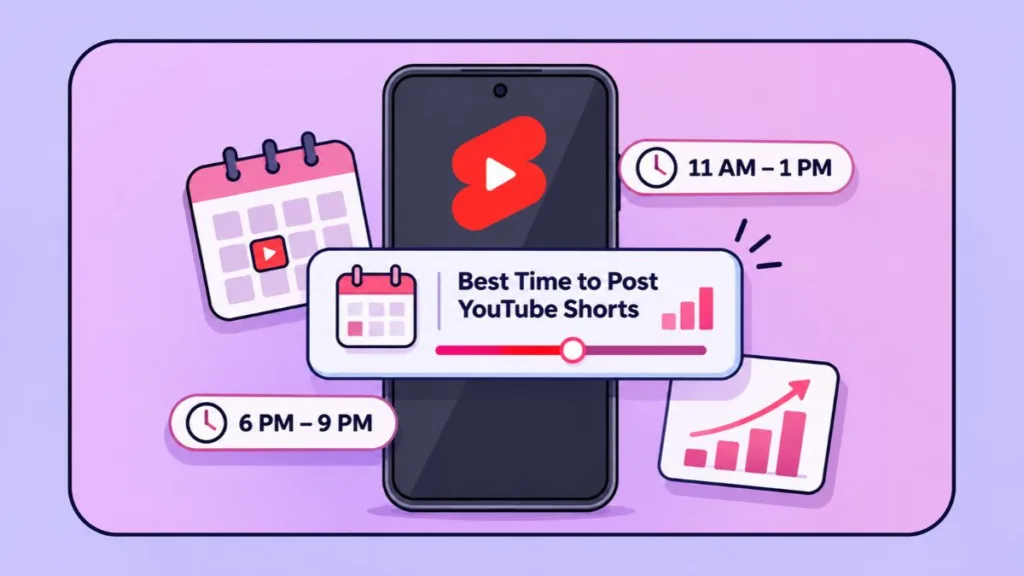
Below, we’ll cover what the research can and can’t tell you, which windows to test first, how to handle your viewers’ time zone, and how to use YouTube Studio to replace general advice with your own data.
Best Time to Post YouTube Shorts: Where to Start
Test 11 AM to 1 PM and 6 PM to 9 PM first, in your viewers’ local time. This day-by-day table is a reasonable first schedule if your channel is new and you have no audience data yet:
| Day | Times to test |
|---|---|
| Monday | 11 AM–1 PM or 6 PM–9 PM |
| Tuesday | 11 AM–12 PM or 6 PM–9 PM |
| Wednesday | 11 AM–1 PM or 6 PM–9 PM |
| Thursday | 12 PM–3 PM or 6 PM–8 PM |
| Friday | 4 PM–7 PM |
| Saturday | 9 AM–11 AM or 6 PM–9 PM |
| Sunday | 9 AM–11 AM or 6 PM–9 PM |
Note: These are testing windows drawn from the research below, not guaranteed peak hours. Treat the table as a hypothesis to check against your own analytics.
What the Research Actually Tells You About Each Day
Here’s how the evidence breaks down by day, along with how much weight we’d give it.
Friday has the strongest case. All three of Buffer’s top individual time slots fell on Friday: 4 PM, 6 PM, and 7 PM. It’s the closest thing to a clear signal in the available data. If you post only a few Shorts a week, we’d make one of them a Friday afternoon or evening upload.
Tuesday late morning has support. Hopper HQ’s 2026 guide points to 11 AM to 12 PM, and that lines up with the late-morning publishing pattern in vidIQ’s analysis of 80 million Shorts uploads.
Thursday afternoon has some support. Birdeye’s research highlights Thursday afternoon for YouTube activity in general, so lunchtime through mid-afternoon is worth testing before you move to evenings.
Monday and Wednesday have no standout study. We’d still use them, because lunch-break and after-work viewing are common patterns. A midweek upload also tells you whether your audience watches steadily or mostly on weekends.
Weekends make sense on logic more than data. People have more free time, so 9 AM to 11 AM and evening slots are reasonable. Sunday mornings are interesting if your viewers browse before the week begins.
There’s a caveat here. A ranking of the “best” slots in a large dataset shows when successful videos were published, and it can’t tell you whether the time caused the success. Creators with established audiences may simply publish at the same hours, which inflates those slots. We read these studies as a map of when people are generally active, not as proof that a given hour boosts a Short.
How Your Audience’s Time Zone Affects YouTube Shorts Posting Times
Time zone is the mistake we’d fix first. If your viewers live elsewhere, a schedule built around your own clock can put your Short out at 3 AM for them. Always plan in your audience’s local time.
The Geography report in YouTube Analytics shows where your viewers are. If they’re spread across several zones, schedule for the one where most of them live and check results before adding a second.
This also changes how you should read the vidIQ numbers. Its 11 AM and 7 PM peaks are in Eastern Time, so they reflect one region’s publishing patterns. If most of your viewers are elsewhere, the part that carries over is the shape of the pattern: a late-morning rise and an evening one.
Some other points:
- Regional Shorts data is thin. We found little large-scale research for individual regions, so treat any region-specific timing as an assumption to test.
- Your niche changes the routine. Working professionals tend to watch in the evening, while students often watch at lunchtime and on weekend mornings. A gaming channel, a study channel, and a business channel can peak hours apart.
- You don’t have to hit the peak exactly. Publishing an hour or two earlier gives your Short a head start before viewing climbs.
Does Posting Time Matter for YouTube Shorts?
It matters, but less than most creators hope. Publishing when your audience is online helps your existing viewers see a Short early. It doesn’t guarantee reach.
YouTube hasn’t published a posting-time formula for Shorts. Its guidance is to learn your audience through YouTube Studio Analytics, and its recommendation system responds to how viewers behave: whether they choose to watch, how long they stay, and whether they seem satisfied.
Our assessment, and it’s an interpretation rather than something YouTube has confirmed, is that Shorts depend less on a specific moment than a scheduled long video does. They’re served through a swipe feed and can keep finding viewers for days. If that’s right, posting time works best as a small advantage in the first hours, and it can’t rescue a weak video.
Popular slots also come with more competition, since other creators read the same research. A strong opening, one clear idea per Short, and a title that describes the video honestly will usually do more than moving an upload by an hour. If a Short isn’t getting views, check retention before you check the clock.
How to Find Your Best Posting Time in YouTube Studio
General research gets you started. Your own data should take over as soon as you have it.
YouTube Studio includes a report called When your viewers are on YouTube. It shows when your audience has been active across the platform.
- Sign in to YouTube Studio with the account linked to your channel and select Analytics from the left menu.
- Open the Audience tab.
- Find the report called When your viewers are on YouTube. It shows a weekly chart in shades of purple, and darker blocks mean more of your viewers are online.
- Look for days and hours where activity is consistently high. If weekdays between 6 PM and 9 PM look dark, that’s your first window.
- Schedule Shorts about one or two hours before that peak and compare results over several weeks.
One limitation to keep in mind is that this chart shows when your viewers are on YouTube as a whole, not specifically when they watch Shorts. It’s a strong starting signal, but it isn’t the final word, so your Shorts results should confirm it.
How to Test Without Fooling Yourself
Most posting-time tests fail because of how they’re run, not because of the data. We’d follow these rules:
- Change one variable at a time. Test a lunchtime window against an evening window, and keep everything else as similar as you can.
- Compare similar videos. If the two uploads differ in topic and quality, you’ll be measuring the content, not the time.
- Give each window several uploads over several weeks. One video proves nothing, and neither does a single good day.
- Judge by more than views. Look at engaged views, average view duration, average percentage viewed, viewed versus swiped away, and audience retention. A slot that brings views but a high swipe-away rate isn’t really working.
- Don’t change the schedule after every upload. The most common mistake we see in creator advice is reacting to a single result.
Once a pattern holds up across a few weeks, lean into those days and hours.
How Often Should You Post YouTube Shorts?
Consistency matters more than volume. A rhythm you can keep up for months beats a burst of effort you can’t sustain. Roughly:
- Daily: This works if you can make good Shorts consistently, and it gives you more data for testing topics and time slots.
- Three to five a week: This is a manageable pace if you’re balancing other work.
- Once or twice a week: This suits videos that need more research or editing.
Ten uploads in a week followed by two weeks of silence tells you far less than steady posting does, and it makes timing tests nearly impossible to read. Also, a Short doesn’t necessarily stop getting views after the first day. It can keep surfacing through recommendations for days or longer, so don’t judge a video by its first few hours.
FAQs About the Best Time to Post YouTube Shorts
What is the best time to upload YouTube Shorts for more views?
Start with 11 AM to 1 PM and 6 PM to 9 PM in your viewers’ local time, then let the Audience report in YouTube Studio set your final schedule.
Is morning or evening better for YouTube Shorts?
Evening is a strong window to test because many people are free after work or study, but late morning and lunchtime suit some audiences better. Post in both for a few weeks and compare retention and swipe-away rates before choosing.
Is Friday the best day to post YouTube Shorts?
Friday has the strongest evidence, since Buffer’s top three slots were all on Friday: 4 PM, 6 PM, and 7 PM. That doesn’t mean it will beat every other day for your channel, so test it against your own results.
What is the best time to post YouTube Shorts for my time zone?
Schedule in your audience’s local time, not yours. Check the Geography report in YouTube Analytics to see where most viewers are, then apply the late-morning and evening windows to that time zone.
Should I post YouTube Shorts every day?
No, daily posting isn’t required. Several good Shorts a week is a fine starting point, and you can post more often once you can keep the quality up.
Can YouTube Shorts get views after several days?
Yes, Shorts can keep getting views through recommendations well after the first few hours. That’s why early numbers alone shouldn’t decide whether a video worked.
Final Thoughts
There’s no universal best time to post YouTube Shorts, and we’d be wary of anyone who claims otherwise. The research points to late mornings, early evenings, and Fridays as places to start, but it describes general activity and can’t promise results for your channel.
Pick two or three windows from the table, schedule them for your viewers’ time zone, and check them against your When your viewers are on YouTube chart. Run the test for a few weeks with similar videos, keep what works, and drop what doesn’t.
Then put most of your effort into the video itself. A strong Short posted at an ordinary time will usually beat a weak one posted at the “perfect” hour.
Check out our latest posts on the Blog Page!