Learn what AI really is with a simple, beginner-friendly explanation. Understand how artificial intelligence works using easy words and real-world examples.
What Is AI? A Simple Explanation for Beginners
You can’t scroll through social media, open a news app, or sit in a business meeting today without hearing those two letters: AI.
- It is powering the chatbots that write emails for you.
- It is behind the weirdly perfect images flooding your feed.
- It is driving cars on highways and diagnosing diseases in hospitals.
But despite the noise, a simple, jargon-free answer to the question “What is AI?” is surprisingly hard to find.
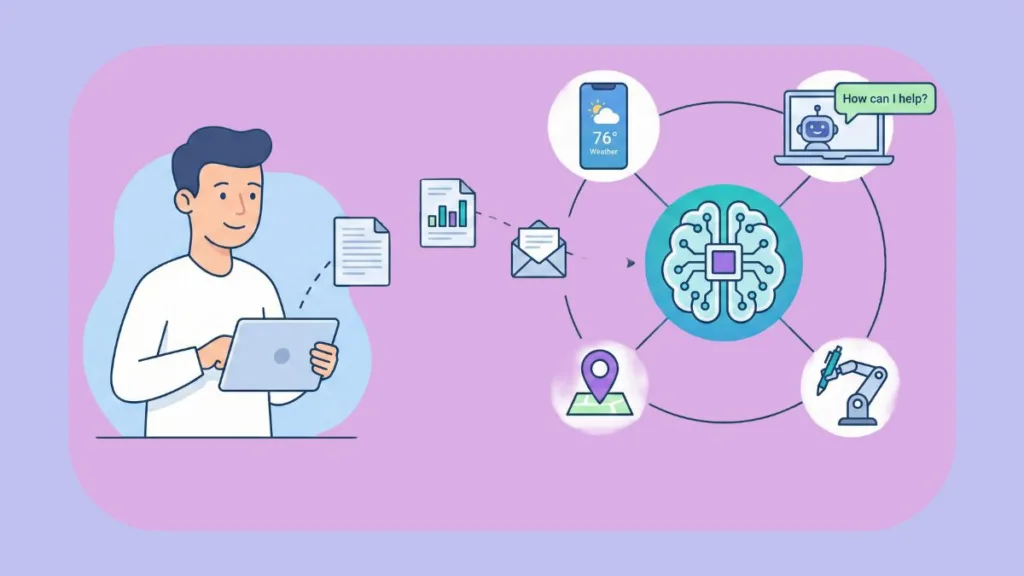
Most explanations swing too far in one direction. They are either overly technical—filled with math and code that alienates the average reader—or they are purely science fiction.
The truth is grounded somewhere in the middle. Artificial Intelligence is a tool, likely the most significant one invented since the internet itself.
This guide is written for non-technical readers, students, and professionals who want clarity—not code.
TL;DR: The Quick Definition
- What is AI? It is software that learns from data instead of following strict rules.
- How does it work? It analyzes massive amounts of information to find patterns—like a child learning to read—and then uses those patterns to make predictions.
- Is it a robot? No. AI is the brain or software; a robot is just the body or hardware.
- Why now? Faster computers and better data have made AI capable of creating content (Generative AI), not just analyzing it.
If you feel like you have fallen behind on the tech curve, do not worry. You haven’t. We are still in the early innings of this revolution. This guide is designed to strip away the hype and explain exactly what AI is, how it works, and why it matters to you, using plain English and real-world examples.
What Is AI in Simple Words: A Beginner Friendly Definition
At its most basic level, Artificial Intelligence (AI) refers to computer systems designed to perform tasks that typically require human intelligence.
These tasks include recognizing speech, making decisions, translating languages, and identifying patterns visually. But the definition goes deeper than just smart computers. To truly understand AI, you have to understand how it differs from the software we have used for the last 50 years.
The Shift From Recipes to Learning in AI
Think of traditional software—like Microsoft Excel or an old-school calculator—as a recipe. A human programmer writes a specific set of instructions: “If the user clicks this button, open that window.” The computer follows these rules blindly. It is obedient, but it is not smart. If you present it with a situation the programmer didn’t predict, the software crashes.
AI is different because it learns. Instead of giving the computer a strict recipe, developers give it data and a goal.
- Traditional Approach: You write code describing exactly what a cat looks like—pointy ears, whiskers, tail. If the cat is turned sideways, the code fails.
- AI Approach: You show the computer 10,000 photos of cats and 10,000 photos of dogs, and you tell it which is which. Eventually, the computer figures out the patterns on its own.
In simple words: AI means teaching computers to learn from experience rather than following a rigid script.
How Does AI Work: The Engine Behind the Intelligence
When people ask “How does AI work?”, they are usually asking about Machine Learning. To understand this, let’s look at how a human child learns to read.
A child starts by seeing letters. They guess what the word is. If they are wrong, a teacher corrects them. If they are right, they get a gold star. Over time, they stop guessing and start reading fluently.
AI follows a nearly identical process using three key components:
1. Data – The Textbook
Just as a student needs a textbook, AI needs data. This serves as the fuel. It can be text from the internet, medical X-rays, or traffic logs. The quality of this data is crucial. If the textbook is full of errors, the student—in this case, the AI—will learn the wrong things.
2. The Algorithm – The Learning Style
Imagine a maze. A traditional computer program is like a map that shows the exact path to the exit. An AI algorithm is different. It is a system that lets the computer run through the maze a million times, bumping into walls and restarting, until it learns the perfect path on its own.
3. Training vs Inference – School vs Work
There are two distinct phases in an AI’s life cycle:
- Training: This is the school phase where the heavy lifting happens. The AI analyzes data, makes mistakes, stands corrected, and updates its internal model.
- Inference: This is the work phase. Once the AI has graduated, it goes out into the real world. When you ask ChatGPT a question, it is performing inference—using what it learned during training to give you an answer.
The Hierarchy: AI vs Machine Learning vs Deep Learning
You will often hear these terms used interchangeably, but there is a clear distinction between Artificial Intelligence vs. Machine Learning. Think of them like Russian nesting dolls.
Artificial Intelligence – The Big Umbrella
This is the broad category. Any technique that enables computers to mimic human behavior falls under AI. This includes simple logic, like a chess computer from the 1990s, all the way to advanced robots.
Machine Learning – The Subset
Machine Learning (ML) is a specific subset of AI. It creates systems that improve at tasks with experience without being explicitly programmed for every outcome.
- Example: Your email spam filter. When you mark an email as “Spam,” the ML model learns from that action and gets better at blocking similar emails in the future.
Deep Learning – The Advanced Technique
Deep Learning is a specialized type of machine learning inspired by the human brain. It uses Neural Networks—layers of mathematical neurons that pass information to one another. This is the technology behind self-driving cars and voice assistants.
The 3 Types of AI: From Chatbots to Sci-Fi
Not all AI is created equal. Experts generally categorize AI into three stages of evolution. It is vital to know which one we are currently using so you don’t fall for fear-mongering headlines.
1. Artificial Narrow Intelligence – ANI
Status: We are here. Also known as Weak AI, this is the only type of AI that currently exists. It is narrow because it is designed to do one specific thing extremely well.
- A chess AI can beat the world champion at chess, but it cannot tell you the weather.
- Siri can tell you the weather, but it cannot drive a car.
Narrow AI mimics intelligence, but it has no consciousness or genuine understanding.
2. Artificial General Intelligence – AGI
Status: Theoretical (The Goal). AGI, or Strong AI, refers to a machine that possesses the ability to understand, learn, and apply knowledge across a wide variety of tasks, just like a human. An AGI system could learn to drive a car, then read a medical textbook and diagnose a patient. We do not have AGI yet.
3. Artificial Super Intelligence – ASI
Status: Hypothetical. This is the level where AI surpasses human intellect in every possible way. This is the stuff of movies and remains firmly in the future.
What Is Generative AI: The Modern Revolution
If AI has been around for decades, why is everyone obsessed with it now? The answer lies in a specific breakthrough called Generative AI.
Until recently, most AI was discriminative. It was used to classify things, such as deciding “Is this a cat or a dog?” Generative AI creates new data.
- Text: Tools like Gemini and ChatGPT can write poems, code, and emails.
- Images: Tools like Midjourney create photorealistic art from a text description.
How It Works: The Next Word Game
Generative text models work on probability. They don’t know facts. They have analyzed so much text that they can predict, with uncanny accuracy, what word comes next in a sentence. If you type “The cat sat on the…”, the AI calculates that “mat” is 80% likely. It picks the most probable path. It is essentially a super-advanced version of the autocomplete on your phone.
7 Real World Examples of AI You Use Every Day
You might think you are new to AI, but you have likely been using it for years. It works quietly in the background, making your digital life smoother. In fact, you use AI more than you think, and it has become indispensable, with at least 10 uses of artificial intelligence in daily life for students and professionals alike.
1. Social Media Feeds
TikTok and Instagram use powerful AI algorithms to track exactly how many seconds you look at a post to predict exactly what content will keep you engaged.
2. Search Engines
Google uses Natural Language Processing (NLP) to understand the intent behind your search. If you search “shoes for red dress,” it understands you are looking for fashion advice, not just pages that contain the words “shoes” and “red.”
3. Banking and Finance
When you swipe your credit card, an AI model instantly compares that transaction against your spending history. If you usually buy coffee in London but suddenly buy a TV in Miami, the AI flags it as fraud in milliseconds.
4. FaceID and Security
Unlocking your phone with your face requires complex 3D mapping. The AI has to recognize you even if you get a haircut, wear glasses, or grow a beard.
5. Smart Home Assistants
Alexa and Google Home use speech recognition to translate sound waves into text, then use NLP to understand the command, and finally execute an action.
6. Navigation
Apps like Waze and Google Maps analyze the movement speed of every user on the road. They predict traffic jams before they happen and route you around them.
7. Customer Support Chatbots
Those little chat windows that pop up on websites? Most of them are AI agents trained on the company’s help documents, capable of resolving simple issues without a human ever getting involved.
Why Is AI Important: The Benefits for Society
Why are companies pouring billions of dollars into this technology?
- Efficiency: AI never sleeps. It can handle repetitive administrative tasks—like data entry—freeing humans to do creative work.
- Healthcare: AI is being used to discover new drugs and detect cancer in radiology scans with greater accuracy than human doctors.
- Personalization: AI allows for mass personalization. In the future, education could be tailored to every single student’s learning style.
The Dark Side: Risks and Challenges of AI
With that power comes responsibility. We cannot discuss what AI is without addressing the concerns. This technology introduces new risks that society must manage.
1. Hallucinations
Generative AI tools are designed to be convincing, not necessarily truthful. They can confidently state facts that are completely wrong. If you want to understand why this happens, read our deep dive on why Generative AI hallucinates. Always verify AI outputs for important tasks.
2. Bias and Fairness
If an AI is trained on biased data, it will make biased decisions. For example, if a hiring AI is trained on resumes from a company that historically only hired men, it might learn to unfairly downgrade resumes containing the word “women’s.”
3. Privacy and Data Security
AI learns from the data you give it. This is why you must be careful about what you type into these chatbots. There are 5 things you should never share with ChatGPT, including financial data and passwords, to keep your personal information safe.
The Future: What Is Agentic AI
If Generative AI is the current wave, Agentic AI is the next one. Right now, you have to prompt AI: “Write me an email.” Agentic AI—often called AI Agents—will be able to act on its own to achieve a goal.
- You: “Plan a vacation to Italy for under $3,000.”
- Agentic AI: It will not just write an itinerary. It will go online, book the flights, reserve the hotels, and add them to your calendar, only asking you for final approval.
We are moving from chatbots that talk to agents that do.
Key Takeaway AI is simply software that learns from data, not a thinking machine with feelings. Its power comes from recognizing patterns to predict outcomes, not from consciousness.
Final Thoughts: The Takeaway
Artificial Intelligence is not magic.
- It is not a monster. It is a mirror.
- It reflects the data we give it—our knowledge, our creativity, and yes, sometimes our biases.
Understanding AI in simple terms empowers you. Instead of fearing the black box, you can see it for what it is: a powerful engine for processing information.
Your Next Step: Don’t just read about it—try it. Go to a tool like ChatGPT, Gemini, or Claude. Ask it to explain a hobby you love. Ask it to write a recipe based on what is in your fridge. The best way to demystify AI is to use it, test its limits, and see how it can help you in your own life.
Check out our latest posts on the Blog Page!