Which GTA game is the best so far? Explore my personal ranking of every major Grand Theft Auto title, from GTA III to GTA V, with personal insights, story analysis, and what makes each game unforgettable.
I got my first PC when I was 10 years old. The very first game I played on it was The Mummy — a game based on The Mummy Returns movie. Not exactly the most legendary title in gaming history, but it was mine, and it sparked something. After that came WWE, Need for Speed, and a growing curiosity about what else was out there.
But there was one game that kept slipping out of reach: Grand Theft Auto. My PC at the time couldn’t handle GTA III or Vice City. Those games were on my radar, but my hardware just wasn’t ready. When I finally upgraded my setup and got GTA III running — laggy and sputtering though it was — I knew I had found something special. That moment marked the real beginning of my gaming life.
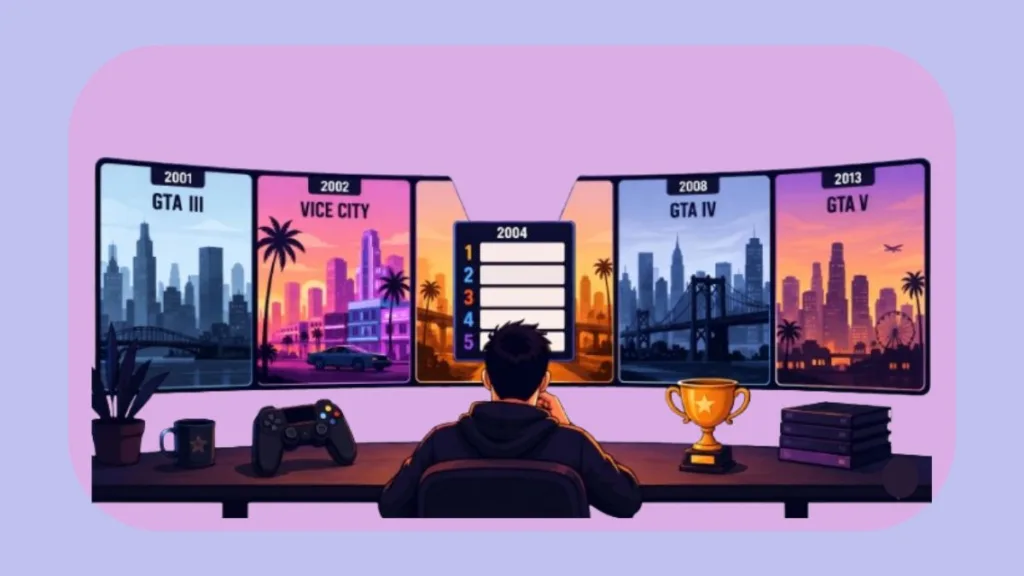
Since then, I’ve played through most of the major GTA titles. And with all the hype building around GTA VI, I’ve been looking back at every entry in the series and asking myself: which one actually holds up as the best?
Here’s how I’d rank them today.
The Thread That Runs Through Every GTA Game: Betrayal
Before I get into individual rankings, there’s one thing that has always struck me about this series. Whether you’re playing a decade-old classic or the most modern entry, one theme keeps showing up: betrayal.
- In GTA III (2001), Claude’s girlfriend Catalina shoots him during a bank robbery and leaves him for dead — literally the opening scene.
- In Vice City (2002), Tommy Vercetti’s boss Sonny Forelli sets him up, sending him on a drug deal that goes wrong from the very start.
- In San Andreas (2004), CJ is stabbed in the back by two of his closest friends — Big Smoke and Ryder — the people he trusted most in Grove Street.
- In GTA IV (2008), Niko Bellic crosses an ocean chasing peace, only to be deceived by Michelle, manipulated by Dimitri Rascalov, and haunted by the wartime treachery of Darko Brevic — the man who sold out his entire unit.
- In GTA V (2013), it’s Michael De Santa who plays the betrayer, turning on his own crew in a deal that sets the whole story in motion.
It’s one of the most consistent creative threads in the series, and I fully expect GTA VI to continue this tradition. Betrayal doesn’t just fuel the plot in these games — it defines the protagonists and gives every act of revenge its weight.
GTA III (2001): Where It All Began
I’ll be upfront: I never got to play GTA III the way it was meant to be played. My PC could barely run it, and I was squinting through frame drops just to experience what the world looked like. But even in that state, I could feel that this game was doing something nobody had done before.
GTA III was the first 3D game in the Grand Theft Auto series, set in Liberty City and following Claude — a silent protagonist betrayed by his girlfriend and left for dead during a bank robbery. The shift from top-down 2D to a fully realized 3D open world was genuinely revolutionary. It went on to become the best-selling game of 2001 in the United States.
Claude is an interesting protagonist — he doesn’t say a single word throughout the entire game. The developers made this choice partly to help players identify with the character and make him whoever they wanted him to be. There’s something oddly powerful about that. You project everything onto him: his anger, his drive for revenge, his silence.
As a game, GTA III is showing its age. The mission design is dated, the controls feel stiff by today’s standards, and there isn’t much story depth beyond the basics. But what it represented when it launched? Absolutely groundbreaking. Without GTA III, none of the games that followed would exist.
GTA Vice City (2002): Style, Chaos, and Tommy Vercetti
Vice City was my introduction to what GTA could be when it had real personality. Set in a sun-soaked, neon-drenched take on 1980s Miami, everything about this game dripped style. It was the first GTA game to feature a speaking protagonist — Tommy Vercetti, voiced by the late Ray Liotta — and that single change made the world feel completely different. While Vice City perfected the formula GTA III introduced, it also gave that formula a genuine voice and a real arc for the first time.
Where Claude was a blank slate, Tommy had ambition, temper, and attitude. His boss Sonny Forelli sends him on what should be a simple drug deal, it gets ambushed, and suddenly Tommy is stranded in Vice City, broke and hunted. The rest of the game is about clawing his way back to the top and making sure Sonny pays.
What Vice City does that GTA III never could is give that revenge story an empire to build. Tommy doesn’t just survive — he takes over. You move from street-level errands for local crime bosses to buying up properties across the city: a taxi company, a car showroom, a film studio, a print works, a nightclub. Each one generates income and adds to the feeling that Tommy is genuinely carving out his own corner of Vice City. By the end, you’re not just getting revenge — you own the place. That progression from hunted outsider to untouchable kingpin is one of the most satisfying arcs in the entire series.
Tommy Vercetti himself is one of Rockstar’s strongest protagonist creations. He’s not a silent avatar and he’s not an everyman — he’s a man out of time, placed in a city that suits him perfectly. Ray Liotta brought a charisma and menace to the role that made Tommy feel like a proper crime movie lead, not just a video game character. There’s a reason people still talk about Tommy Vercetti as one of the definitive GTA protagonists even now, over two decades later.
The setting also did something remarkable for gaming culture at large. The 1980s aesthetic — the pastel suits, the synth-heavy radio stations, the Miami Vice energy — became iconic in a way that transcended the game. You hear certain tracks from the Vice City radio and they’re instantly recognizable, even to people who never played it. That’s how deeply it embedded itself into popular culture.
Vice City gets credit for building on GTA III’s foundation and proving the series could have a genuine cinematic voice. It sold 17.5 million copies, riding the momentum of GTA III’s success while offering something distinct enough to stand on its own.
For me personally, Vice City sits a step below San Andreas and GTA IV in terms of emotional weight. But it’s an undeniably strong entry — richer than it often gets credit for, and in many ways the template that San Andreas then exploded into something much larger.
GTA San Andreas (2004): The OG Classic I’ve Played Eight Times
This is where things get personal.
I have played San Andreas eight times. Eight. Plus twice more through the Definitive Edition. If that tells you anything, it’s that this game hit different for me — and for a lot of people in my generation.
Released in October 2004, San Andreas is set within the fictional U.S. state of San Andreas, based on California and Nevada in 1992, and follows Carl “CJ” Johnson, who returns home after his mother’s murder. You come back to Los Santos to find your gang in shambles, your friends scattered, and the streets controlled by everyone except you. Then the story slowly opens up into something much bigger — drug trade, corrupt cops, political conspiracy, and a cross-state journey through three massive cities.
The open world consisted of three major metropolitan cities: Los Santos, San Fierro, and Las Venturas — each with its own identity and feel. While Vice City built a rich single city and gave it personality, San Andreas exploded that concept entirely, creating an entire fictional state with distinct geography, culture, and atmosphere in every region. The game also introduced RPG mechanics: you could work out, gain muscle, get fat, learn to swim, take driving lessons, and customize CJ’s look from head to toe. At the time, no other game was doing anything close to this.
The Guinness World Records 2009 Gamer’s Edition listed San Andreas as the best-selling PlayStation 2 game of all time, with 17.33 million copies sold for that console alone. Those numbers reflect something real — this game wasn’t just popular, it was loved.
The betrayal in San Andreas is also the most personal in the entire series. Big Smoke and Ryder weren’t just enemies — they were CJ’s boys. Grove Street. His people. When it comes out that they’ve been working with the Ballas and corrupt cop Frank Tenpenny the whole time, it hits harder than any twist in the franchise. San Andreas teaches you what betrayal looks like when it comes from people you grew up with.
The story is also grounded in real history. The narrative is based on multiple real-life events in Los Angeles, including the Bloods and Crips street gang rivalry, the 1990s crack epidemic, the 1992 Los Angeles riots, and the Rampart scandal. That context gives the story a weight that goes beyond just a crime game.
Is San Andreas perfect? No. Some missions are frustrating, a few sections drag, and the graphics show their age even in the Definitive Edition. But the sheer scale of what this game attempted — and mostly pulled off — is remarkable even two decades later.
GTA IV (2008): The Hardest-Hitting Story in the Series
Here’s where I have to be honest about something: GTA IV is the game that moved me the most.
Not the most fun to replay. Not the most feature-rich. But the most emotionally real.
Set in the fictional Liberty City, based on New York City, the single-player story follows Eastern European war veteran Niko Bellic and his attempts to escape his past while under pressure from high-profile criminals. Niko comes to America on a boat. He’s been told by his cousin Roman that Liberty City is full of opportunity — mansions, sports cars, the American Dream. He arrives to find a cramped apartment and a city that chews people up for fun.
Within the game’s storyline, Niko is an ex-soldier shaped by his experiences fighting in an unspecified war, developing a very cynical view on life. After becoming involved with a Russian crime syndicate and discovering that his unit was sold out to enemy forces, he decides to move to Liberty City to pursue the American Dream.
Niko’s entire journey is haunted by one question: who sold out his squad during the war? That mystery — and the brutal answer waiting at the end — is the emotional spine of the whole game. Along the way, Michelle reveals herself as a government informant. Dimitri Rascalov turns on Niko just as things seem to be improving. And Darko Brevic, when Niko finally finds him, turns out to be a broken, pathetic man who sold out his unit for a few thousand dollars. That moment, and what you choose to do with it, is one of the most affecting scenes in the history of the medium.
The story of Niko Bellic — a somber story of a dangerous man who just wants to find peace in a city with no hope for it — is one of the most effective crime thrillers ever seen in video games. There’s a weightiness to Niko’s character arc, a thematic story about the cost of vengeance and the power of forgiveness.
A greater emphasis on physics courtesy of the innovative Euphoria Physics Engine made even the simple act of navigating Liberty City far weightier, with bodies behaving realistically and car handling aligned with the weight distribution of each vehicle. GTA IV was also the first game in the series to introduce ragdoll physics. The world felt heavy, real, and lived-in in a way no prior GTA game had managed.
GTA IV’s story resonates with me personally because Niko’s experiences map onto something universal. The pain of trusting someone who turns out to be working against you. The cost of chasing revenge when the thing you’re chasing turns out to be hollow. These aren’t just video game themes — they’re life.
Where San Andreas teaches you what betrayal looks like, GTA IV shows you what it does to you.
GTA V (2013): The Biggest, Not Necessarily the Best
GTA V is the undeniable commercial king of the series. It has shipped 225 million copies across the globe, making it one of the best-selling video games in history, trailing only Minecraft. The game earned $815 million in its first 24 hours and hit $1 billion within three days. Those numbers are staggering.
And the game earns a lot of that love. Let’s be fair about what GTA V actually does well, because there’s plenty.
The heist structure is genuinely excellent. For the first time in the series, Rockstar built elaborate multi-stage heist missions that let you choose your crew, your approach, and your cut. The Paleto Score. The Bureau Raid. The Union Depository. These are some of the most cinematic set pieces in gaming, and they hold up brilliantly. For anyone who played GTA IV and wanted the missions to feel as ambitious as the story, GTA V delivered on that front in a big way.
Trevor Philips is one of Rockstar’s most unpredictable creations. He’s disturbing, funny, and oddly compelling in equal measure — a walking embodiment of the chaos the series has always celebrated. His introduction sequence alone is one of the most memorable in GTA history.
The world itself is extraordinary. Los Santos is built with an almost obsessive level of environmental detail — every neighbourhood feels lived-in, every radio station has something to say about the state of modern America. GTA V’s satirical lens on consumer culture, celebrity worship, social media, and political corruption is sharp and genuinely funny, and it reflects how well Rockstar understands the world it’s commenting on. That sense of satire running through every corner of the map is one of the things that makes the game hold up even today.
And then there’s GTA Online, which turned the whole package into a live-service ecosystem that’s still running well over a decade later. The fact that GTA V continues shipping millions of copies per quarter in 2026 — thirteen years after release — is almost entirely because of what GTA Online became.
So yes. GTA V gave us an enormous amount.
But here’s where I have to be honest: GTA V is primarily Michael’s story, and even Michael’s story never quite reaches the emotional depths of what came before it. Franklin is there, Trevor is an entertaining wildcard, but the emotional core belongs to Michael — his failed retirement, his dysfunctional family, his deal with the feds, and his own act of betrayal against his crew years before the game even starts. The three-protagonist structure, as ambitious as it is, also means none of them receive the sustained development Niko got across a single, focused narrative.
GTA V gave us three protagonists, but GTA IV proved that one well-written character can leave a bigger impact than three entertaining ones.
The problem isn’t that GTA V is bad. The problem is that it prioritizes spectacle over soul. You get an enormous world and three charismatic leads, but the story is entertaining without being truly affecting. It never sits with you the way GTA IV does. GTA V is a great game — one of the best ever made by most objective measures — but it doesn’t hold the same place in my heart that San Andreas or GTA IV does.
So, Which GTA Game Is Actually the Best?
This is genuinely one of the hardest questions in gaming for me personally. If you’re talking about legacy, features, replayability, and sheer cultural impact, San Andreas wins. It redefined what an open-world game could be. It has a story rooted in real historical events, more content than most games twice its size, and an emotional punch in its betrayal arc that still hits. I’ve gone back to it ten times for a reason.
But if you’re talking about storytelling, character depth, and the feeling of inhabiting someone’s actual pain — GTA IV wins. Niko Bellic is the most human protagonist the series has ever given us. His story makes you feel the weight of every decision, every loss, every misplaced trust. It’s not the most fun GTA game. It’s the most real one.
The way I think about it:
- San Andreas shows you what betrayal looks like from the outside — the shock of discovering that the people closest to you were never who you thought.
- GTA IV shows you what betrayal does on the inside — the grief, the obsession, the hollow victory of finally getting your answer.
Both are lessons worth learning. Both are games worth playing.
IGN and many others rank GTA V at the top of the franchise, and from a technical and commercial standpoint, that argument is hard to dispute. The GTA franchise has now sold over 465 million units worldwide. GTA V is the engine driving most of that. But the best-selling game and the best game aren’t always the same thing.
For me, the answer is a tie — and I’m not apologizing for that. San Andreas and GTA IV share the top spot, and I expect GTA VI will have a lot to live up to when it finally arrives.
Final Thoughts
The Grand Theft Auto series has earned its place as one of the most important franchises in gaming history. From the laggy, barely-running version of GTA III I managed to squeeze out of my first PC upgrade, to the emotional gut-punch of Niko Bellic’s story, every game has left its mark.
Looking back, it’s funny to think that the games my old computer couldn’t even run ended up becoming the franchise that shaped my taste in storytelling. GTA III was just barely playable on that hardware. Vice City was out of reach entirely. And yet those games — and everything that followed — became the foundation of how I think about narrative, character, and what games are actually capable of expressing.
If you haven’t played through the entire mainline series, I genuinely recommend doing it. Not just for the gameplay, but for the storytelling evolution. Watch how Rockstar’s writing matured from game to game. Notice how the theme of betrayal shapes every protagonist in a different way. And pay attention to how each world — from the 80s glam of Vice City to the sun-baked streets of San Andreas to the cold rain of Liberty City — reflects the emotional tone of the story being told inside it.
What’s your pick for the best GTA game? Drop your thoughts in the comments — I’d love to hear where people land on this.
Check out our latest posts on the Blog Page!